
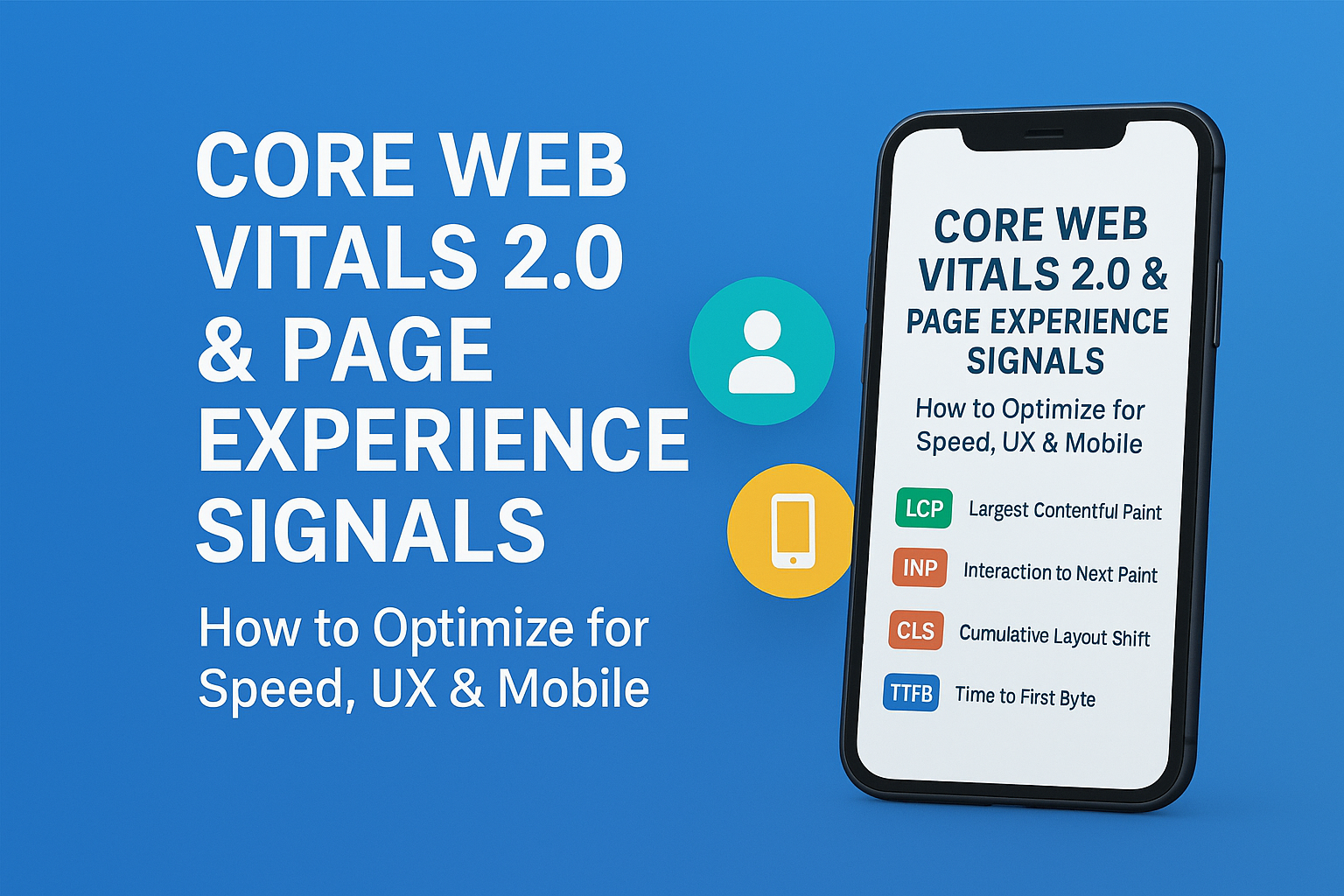
Core Web Vitals 2.0 & Page Experience Signals: How to Optimize for Speed, UX & Mobile
- What Are Core Web Vitals 2.0?
- Core Metrics in Core Web Vitals 2.0:
- What Are Page Experience Signals?
- Key Page Experience Signals:
- Why Core Web Vitals 2.0 & Page Experience Matter for SEO
- How to Optimize for Core Web Vitals 2.0
- Core Web Vitals 2.0 Optimization Strategies
- 1. Optimize Largest Contentful Paint (LCP)
- 2. Improve Interaction to Next Paint (INP)
- 3. Reduce Cumulative Layout Shift (CLS)
- 4. Enhance Time to First Byte (TTFB)
- 5. Ensure Smoothness & Animation Stability
- How to Optimize for Page Experience Signals
- Page Experience Signals Optimization Guide
- 1. Mobile-Friendliness
- 2. Secure HTTPS
- 3. Avoid Intrusive Interstitials
- 4. Ensure Safe Browsing
- 5. Accessibility
- Tools to Measure Core Web Vitals 2.0 & Page Experience
- Common Mistakes to Avoid
- The Future of SEO with Core Web Vitals 2.0
Google has made one thing crystal clear: user experience is SEO. As of 2025, Core Web Vitals 2.0 and Page Experience signals are central to ranking well on search engines. Forget stuffing keywords—your site now needs to be fast, mobile-friendly, and smooth to navigate if you want to dominate search results.
This comprehensive guide breaks down what Core Web Vitals 2.0 & Page Experience Signals mean, why they matter, and how to optimize your website for speed, UX, and mobile-first indexing.
What Are Core Web Vitals 2.0?
Core Web Vitals are Google’s set of performance metrics designed to measure real-world user experience. In 2025, Google introduced Core Web Vitals 2.0, refining metrics to better capture user satisfaction.
Core Metrics in Core Web Vitals 2.0:
-
Largest Contentful Paint (LCP) → Measures loading performance. Aim: under 2.5 seconds.
-
Interaction to Next Paint (INP) → Replaced FID, measures responsiveness and how quickly the site reacts to user actions.
-
Cumulative Layout Shift (CLS) → Measures visual stability (no shifting elements). Aim: < 0.1.
-
Time to First Byte (TTFB) → Measures server responsiveness. Faster is better.
-
Smoothness Metrics (New in 2.0) → Measures scrolling & animation fluidity.
👉 Together, these metrics ensure users get a fast, stable, and frustration-free experience.
What Are Page Experience Signals?
Page Experience Signals combine Core Web Vitals 2.0 with other ranking factors related to usability.
Key Page Experience Signals:
-
Mobile-friendliness: Fully responsive design.
-
HTTPS security: Secure browsing with SSL.
-
No intrusive interstitials: Avoid annoying pop-ups that block content.
-
Safe browsing: No malware, deceptive content, or phishing.
-
Accessible design: Usable by all, including disabled users.
Together, Core Web Vitals 2.0 + Page Experience signals define how Google judges your site’s overall quality for users.
Why Core Web Vitals 2.0 & Page Experience Matter for SEO
Google’s goal is simple: rank the websites that users love most. In 2025, performance signals are weighted more heavily than ever because they directly impact:
-
Search rankings: Better scores = higher visibility.
-
Bounce rates: Faster pages = fewer users leaving.
-
Conversion rates: Smooth UX drives purchases, leads, and engagement.
-
Mobile-first indexing: Google primarily evaluates your mobile experience, not desktop.
Bottom line: Core Web Vitals 2.0 & Page Experience optimization is no longer optional—it’s essential.
How to Optimize for Core Web Vitals 2.0
Let’s break down the most effective strategies for each metric.
Core Web Vitals 2.0 Optimization Strategies
1. Optimize Largest Contentful Paint (LCP)
Goal: Page’s main content loads in under 2.5 seconds.
Action Tips:
-
Use next-gen image formats like WebP or AVIF.
-
Enable lazy loading for below-the-fold images.
-
Minify and compress CSS/JavaScript.
-
Use a Content Delivery Network (CDN) for global delivery.
2. Improve Interaction to Next Paint (INP)
Goal: Smooth and fast interactivity.
Action Tips:
-
Minimize heavy JavaScript execution.
-
Break long tasks into smaller chunks.
-
Use browser caching to reduce delays.
-
Optimize event handlers (click, scroll, tap).
3. Reduce Cumulative Layout Shift (CLS)
Goal: Prevent content from shifting unexpectedly.
Action Tips:
-
Set size attributes for images and videos.
-
Reserve space for ads and embeds.
-
Avoid inserting content above existing elements dynamically.
-
Use CSS transforms instead of layout shifts.
4. Enhance Time to First Byte (TTFB)
Goal: Server responds quickly.
Action Tips:
-
Upgrade to faster hosting or dedicated servers.
-
Optimize database queries.
-
Use server-side caching like Varnish or Nginx.
-
Reduce third-party scripts.
5. Ensure Smoothness & Animation Stability
Goal: Seamless scrolling and animations.
Action Tips:
-
Use GPU-accelerated animations.
-
Avoid triggering layout recalculations.
-
Optimize video & media playback.
-
Test with Chrome DevTools Performance tab.
How to Optimize for Page Experience Signals
Beyond technical metrics, Page Experience is about overall usability.
Page Experience Signals Optimization Guide
1. Mobile-Friendliness
-
Use responsive web design (RWD).
-
Optimize fonts, buttons, and touch targets.
-
Test with Google’s Mobile-Friendly Test Tool.
2. Secure HTTPS
-
Install and renew SSL certificates.
-
Redirect all HTTP to HTTPS.
-
Display trust badges on e-commerce checkout.
3. Avoid Intrusive Interstitials
-
Replace pop-ups with non-intrusive banners.
-
Delay offers until after initial content loads.
-
Keep cookie banners small and dismissible.
4. Ensure Safe Browsing
-
Regularly scan your site for malware.
-
Avoid deceptive download buttons or ads.
-
Use Google Search Console Security Reports.
5. Accessibility
-
Add alt text to images.
-
Ensure proper color contrast.
-
Implement ARIA labels for screen readers.
-
Provide keyboard navigation.
Tools to Measure Core Web Vitals 2.0 & Page Experience
-
Google PageSpeed Insights → Detailed performance analysis.
-
Lighthouse → Developer audit tool.
-
Search Console Core Web Vitals Report → Tracks site-wide issues.
-
WebPageTest → Advanced speed breakdown.
-
Chrome UX Report (CrUX) → Real user experience data.
Common Mistakes to Avoid
-
Relying only on desktop optimization (mobile-first rules).
-
Ignoring JavaScript execution delays.
-
Using oversized media without compression.
-
Overloading pages with third-party scripts.
-
Neglecting accessibility features.
The Future of SEO with Core Web Vitals 2.0
Google’s AI-driven search experiences prioritize fast, mobile-friendly websites. Expect these future trends:
-
AI-powered performance scoring with predictive metrics.
-
Voice and visual search UX optimization becoming vital.
-
Zero-tolerance for poor mobile UX in rankings.
-
Integration of accessibility metrics into ranking signals.
In short: Speed, UX, and mobile optimization will be the new SEO foundation.
Core Web Vitals 2.o and Page Experience Signals represent Google’s commitment to rewarding user-first websites. To score high in 2025, you must deliver:
-
Fast load times (LCP & TTFB)
-
Smooth interactions (INP & animations)
-
Stable layouts (CLS)
-
Mobile-first, secure, accessible designs
By optimizing for Core Web Vitals 2.o & Page Experience Signals, you not only improve your search rankings but also create a seamless, engaging user experience that drives conversions and brand loyalty.
The future of SEO belongs to websites that prioritize people, not just algorithms.