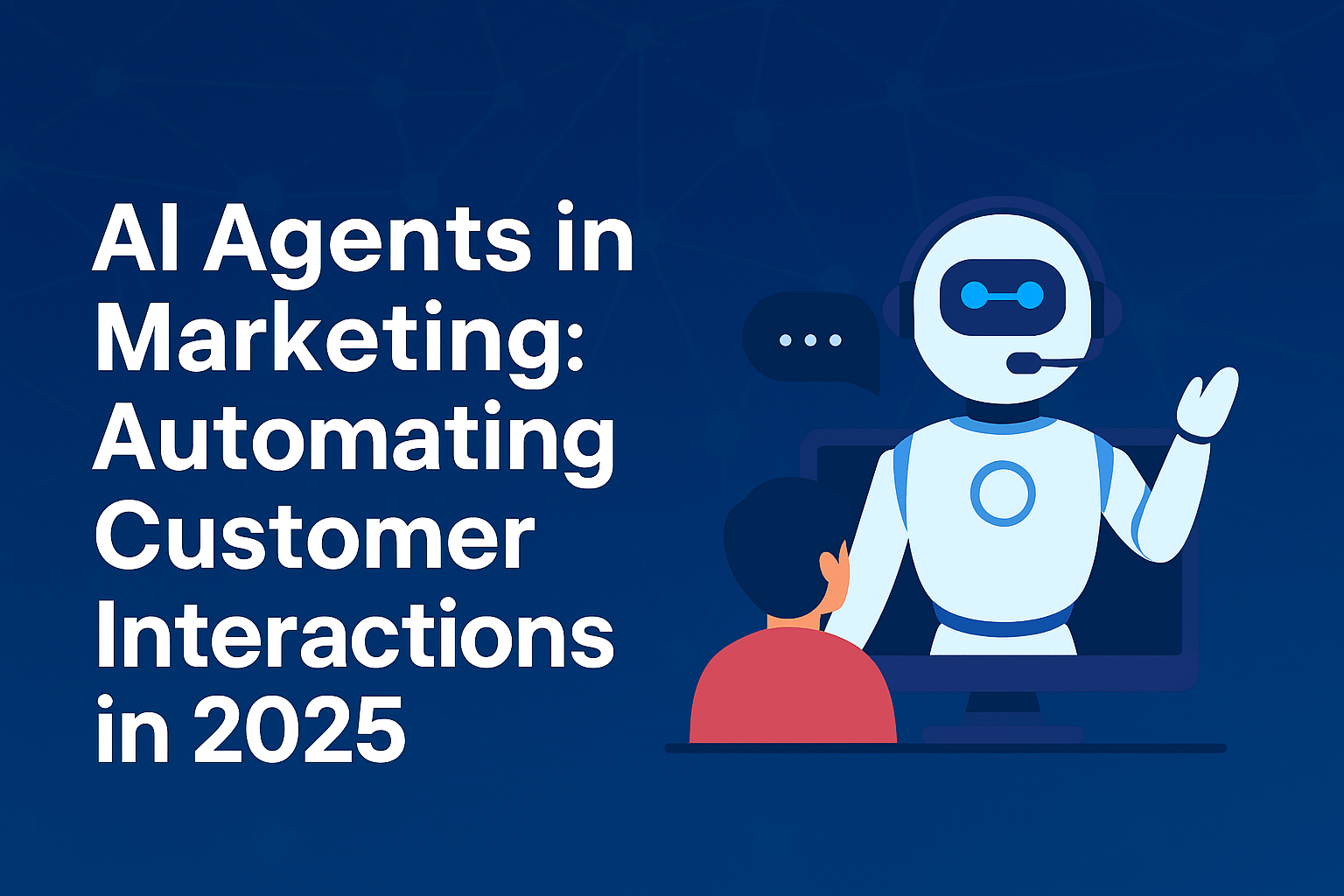
AI Agents in Marketing: Automating Customer Interactions in 2025
- What are AI Agents in Marketing?
- Why AI Agents Matter in Marketing 2025
- 1. Rising customer expectations
- 2. Complexity of modern marketing workflows
- 3. Efficiency gains and cost savings
- 4. Stronger personalisation at scale
- 5. Better decision-making
- Key Use Cases for AI Agents in Marketing
- Customer Interaction & Engagement
- Personalised Content & Dynamic Offers
- Marketing Campaign Automation
- Audience Segmentation & Targeting
- Analytics, Insights & Optimization
- How to Implement AI Agents in Your Marketing Strategy
- Step 1: Define clear objectives
- Step 2: Choose the right platform and tools
- Step 3: Integrate your data foundation
- Step 4: Start small & scale
- Step 5: Build workflows and guardrails
- Step 6: Monitor, measure & refine
- Step 7: Maintain ethical, privacy and security standards
- Challenges & Considerations
- Benefits Realised: Metrics & Outcomes
- Trends to Watch in 2025 for AI Agents in Marketing
- Multi-agent systems & autonomous workflows
- Integration with generative AI & real-time interaction
- Greater accessibility for SMBs
- Ethical AI and intelligent guardrails
- Cross-channel orchestration
- Practical Example: Automating Customer Interactions with AI Agents
- Best Practices & Tips for Marketers
- Future Outlook: What’s Next after 2025?
In the rapidly evolving digital landscape, marketing teams are under increasing pressure to deliver personalized experiences, real-time responses, and measurable results. Enter AI agents in marketing—an innovation that’s reshaping how brands engage with customers, streamline workflows, and maximize ROI. This article examines how these intelligent systems operate, why they’re becoming indispensable in 2025, and how you can implement them effectively using modern marketing automation tools.
What are AI Agents in Marketing?
The term AI agents in marketing refers to autonomous or semi-autonomous software systems that deploy artificial intelligence to perceive data, reason, act, and adapt within marketing workflows. According to Boston Consulting Group (BCG), AI agents go beyond traditional rule-based automation by analysing data, planning tasks, acting on them, and continuously improving.
Unlike a simple chatbot or a marketing automation rule (“if this happens, send that email”), these agents can determine which task to execute next, select channels, personalise content, and optimise based on outcomes. For example, as noted by Salesforce, its “Agentforce” platform is designed to shift AI from being reactive to proactive—a hallmark trait of an agent.
In the world of digital marketing, that means:
-
analysing user behaviour in real-time
-
selecting most relevant content or offer
-
automating interactions across channels
-
continuously optimising for better outcomes
Why AI Agents Matter in Marketing 2025
1. Rising customer expectations
In 2025, customers expect instant, relevant, and seamless interactions across channels. They don’t just want a reply—they want the right content at the right moment. AI agents make this possible.
2. Complexity of modern marketing workflows
With more channels (social, email, chat, voice, apps), more data, and higher privacy/regulation demands, traditional automation struggles. AI agents rise to this complexity by adapting in real time.
3. Efficiency gains and cost savings
Brands implementing AI agents report significant productivity improvements. For example, a platform like Relevance AI notes improvements such as 15-30% higher engagement and 20-40% time savings on repetitive marketing tasks.
4. Stronger personalisation at scale
AI agents enable deep segmentation, dynamic content and interaction flows. They can personalise content, channel, timing and context for each customer—a major differentiator.
5. Better decision-making
Rather than relying solely on human decisions and static rules, AI agents bring data-driven decision capabilities: “perceive → reason → act” loops as defined by BCG.
In short: If you’re serious about marketing in 2025, integrating AI agents is less of an option and more of a necessity.
Key Use Cases for AI Agents in Marketing
Customer Interaction & Engagement
AI agents can manage real-time interactions across chat, voice, email and social. They can identify what the customer is trying to do, select the best content or offer, and respond accordingly—with minimal manual oversight.
Personalised Content & Dynamic Offers
By analysing user behaviour, preferences and context, the agent can pick and deliver the most relevant content or offer. This goes beyond “Hello {first_name}”: it’s about delivering contextually intelligent experiences.
Marketing Campaign Automation
Modern marketing campaigns often involve multiple steps, channels and decision branches. AI agents can orchestrate these—generating briefs, selecting segments, producing content, scheduling delivery, monitoring results, and adjusting. For instance, Salesforce’s Agentforce can build end-to-end campaigns including audience segmentation, content generation and journey mapping.
Audience Segmentation & Targeting
Rather than static segments based on demographics, AI agents can dynamically segment audiences based on behaviour, intent, engagement patterns and context. They can also optimise targeting and spend.
Analytics, Insights & Optimization
AI agents can monitor performance, detect patterns, run A/B tests, and optimise under the hood—freeing marketers to focus on strategy.
How to Implement AI Agents in Your Marketing Strategy
Step 1: Define clear objectives
Start by identifying the customer interactions you want to automate or optimise. It could be responding to queries, nurturing leads, recommending products, or running cross-channel campaigns.
Step 2: Choose the right platform and tools
Look at platforms that support agent-based automation (not just rule-based). For example, Relevance AI and others offer marketing-specific “AI agents”.
Step 3: Integrate your data foundation
AI agents rely on quality data: customer profiles, behaviour, CRM history, segmentation, channel data. Ensure your data stack is properly integrated and accessible.
Step 4: Start small & scale
Experts recommend starting with a focused use case rather than trying to automate everything at once.
Step 5: Build workflows and guardrails
Set up workflows where the agent can act, but within defined boundaries. Human oversight remains important for quality control, compliance and alignment.
Step 6: Monitor, measure & refine
Track key metrics: engagement rate, conversion, response time, cost per lead, ROI. Use feedback loops to continuously train and optimise the agent.
Step 7: Maintain ethical, privacy and security standards
Because agents act autonomously, ensure you have clear policies regarding data use, transparency, and guardrails to avoid bias, misuse or over-automation.
Challenges & Considerations
While AI agents are powerful, marketers should be aware of potential pitfalls.
-
Data quality: Poor, incomplete or siloed data will undermine performance.
-
Over-automation risk: Automation doesn’t mean no human oversight. Some tasks still require human insight and creativity. As one expert noted: “just because something can be automated doesn’t mean it should be.”
-
Integration complexity: Agents often need to connect to multiple systems (CRM, CMS, analytics) and make sure workflows align.
-
Change management: Teams may need new skills to work with agents — monitoring, fine-tuning, interpreting AI-driven insights.
-
Ethics, privacy & guardrails: Autonomous actions must be aligned with brand standards, legal/compliance frameworks and customer trust.
Benefits Realised: Metrics & Outcomes
Some of the measurable benefits include:
-
Higher engagement and conversions: Because interactions are more personalised, timely and relevant.
-
Time and cost savings: Marketers can save 20-40% time on routine tasks and reduce ad wastage by better targeting.
-
Improved campaign performance: Faster execution, smarter optimisation, better ROI.
-
Scalable personalisation: Agents allow brands to personalise at scale—something previously limited by resource constraints.
-
Competitive advantage: Early adopters gain lead in customer experience, speed and agility in campaign management.
Trends to Watch in 2025 for AI Agents in Marketing
Multi-agent systems & autonomous workflows
The future will see not only single AI agents but networks of agents collaborating across functions (content generation, lead qualification, campaign execution). Research shows how multi-agent systems simulate consumer behaviour and optimise strategies.
Integration with generative AI & real-time interaction
Agents will increasingly leverage large language models (LLMs) and generative AI to create content, adapt messaging, and engage customers in natural language.
Greater accessibility for SMBs
What was once the domain of large enterprises is now becoming accessible for small and medium businesses, thanks to more affordable platforms and pre-built agent templates.
Ethical AI and intelligent guardrails
As agents take more autonomous action, ensuring transparency, fairness, data protection and human-in-the-loop becomes even more critical.
Cross-channel orchestration
Agents will increasingly orchestrate across voice assistants, chatbots, mobile apps, email, social and web—ensuring seamless customer journeys.
Practical Example: Automating Customer Interactions with AI Agents
Imagine a mid-sized e-commerce brand that wants to improve post-purchase engagement and up-sell. Here’s how they might deploy an AI agent:
-
Data integration: Pull purchase history, browsing behaviour, demographic data and support tickets into the CRM.
-
Agent design: Define an “engagement agent” whose role is to monitor recent orders, identify likely up-sell or cross-sell opportunities, and trigger personalised messages.
-
Workflow:
-
When a customer completes a purchase, the agent analyses data and picks a next-best-action (e.g., recommend related product, invite to feedback survey, offer loyalty points).
-
The agent sends a personalised email or app push notification.
-
The agent monitors response and modifies the next action (e.g., send reminder, change offer, escalate to human).
-
-
Testing & optimisation: Agent runs A/B tests, monitors performance, refines segmentation, timing and content.
-
Results: Engagement increases, repeat purchase rate rises, manual workload drops and ROI improves.
Such an implementation touches the focus keyphrase “AI agents in marketing” and relies on marketing automation tools and processes.
Best Practices & Tips for Marketers
-
Don’t wait for perfection — start small. Pick a single use case, validate results, then scale.
-
Ensure you have a data foundation in place. Garbage-in, garbage-out still applies.
-
Maintain human oversight and guardrails. Let agents act, but define usage boundaries.
-
Monitor and refine continuously—agents improve over time via feedback loops.
-
Align your organisational culture: training teams to work with agents, not be replaced by them.
-
Prioritise ethics, transparency and customer trust. Automated interactions must feel personalised, not robotic or intrusive.
-
Choose vendor/platform with flexibility — you may want to customise your own agent workflows rather than a one-size-fits-all solution.
-
Measure the right KPIs — not just automation, but engagement, conversion, customer satisfaction and lifetime value.
Future Outlook: What’s Next after 2025?
As we look beyond 2025, we expect:
-
More autonomous decision-making: Agents will increasingly take action without human prompts, within guardrails.
-
Deeper collaboration between humans & agents: Humans will focus on strategy and creativity; agents will handle routine, data-driven tasks. Research shows human-AI teams perform better than human-only teams in ad production.
-
Smarter multi-agent ecosystems: Marketing, sales, service agents will coordinate across functions, enabling seamless customer experiences.
-
Greater democratization: Smaller brands will access sophisticated agent-capabilities previously reserved for enterprise.
-
Ethical and regulatory frameworks: With autonomous agents acting on customer data, regulation will catch up and brands will need to ensure compliance and trust.
The rise of AI agents in marketing represents a major shift in how brands manage customer interactions, campaigns and personalisation at scale. By automating smartly—with the right data, guardrails and strategy—marketers can deliver richer experiences, streamline operations, and remain competitive in 2025 and beyond.
If your brand hasn’t yet explored agents within your marketing automation tools, now is the time. Start with a clear objective, choose the right platform, integrate your data, build the workflow and measure constantly. The payoff? More personalised customer interactions, faster execution, and a marketing function ready for the future.