Vibe Coding: How AI Is Reshaping Web Development in 2025
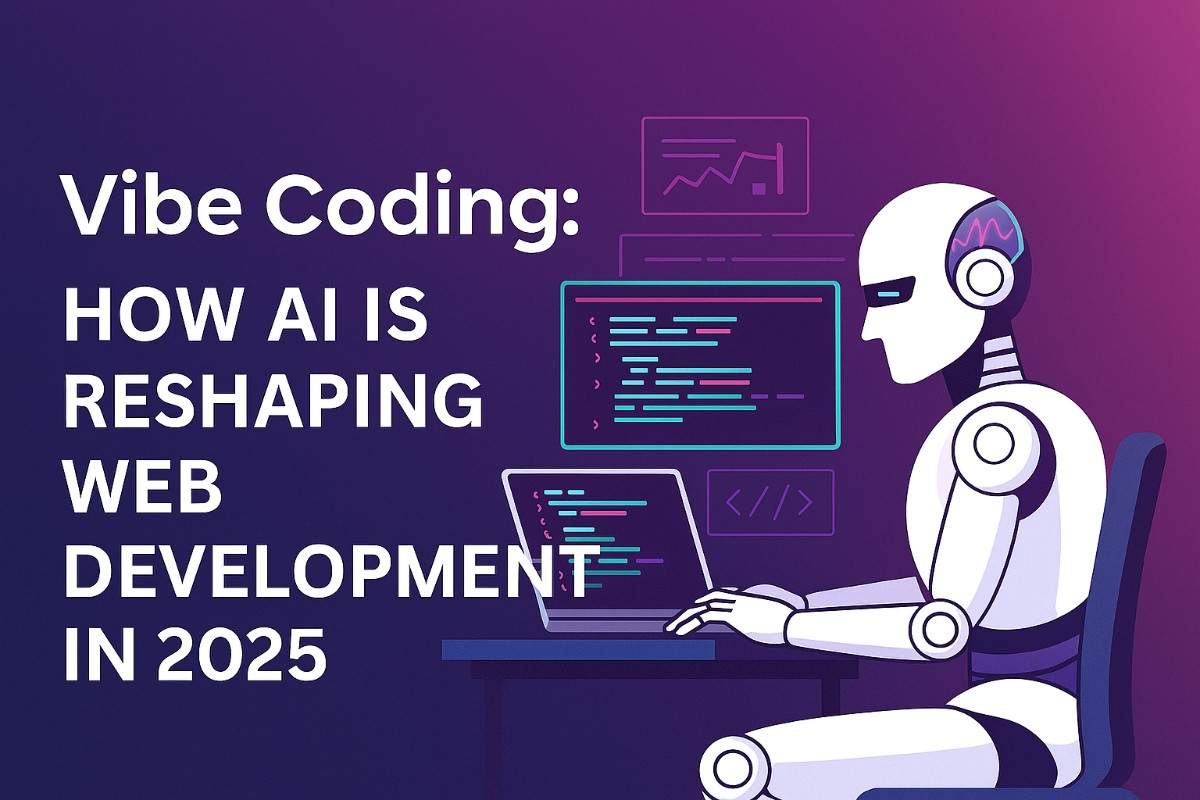
In 2025, web development is undergoing a seismic transformation. The concept of vibe coding—an AI-first, natural-language-driven approach to writing software—is rapidly redefining how developers build websites and applications. Gone are the days of laboriously writing every line of code; instead, developers lean into AI to understand high-level goals, iterate, and refine. This shift is reshaping web development in ways that are faster, more accessible, and more experimental.
This article explores how vibe coding works, why it’s gaining traction, and what it means for the future of web development. We’ll delve into the key trends, challenges, and opportunities, and explain how AI is fundamentally reshaping web development in 2025.
What Is Vibe Coding?
Vibe coding is a term coined in early 2025—popularized notably by Andrej Karpathy—to describe a new paradigm in software development. Instead of manually writing code, developers simply describe what they want to build in natural language to a large language model (LLM). The AI does the heavy lifting: it generates code, runs it, tests it, and then the developer provides feedback, refining the system through iteration.
Key characteristics of vibe coding:
-
Prompt-first development: Developers use plain English (or their native language) to communicate ideas, features, or functionality.
-
No manual review: Unlike traditional pair programming or AI-assisted coding, in vibe coding developers often do not examine every line of the AI-generated code. They trust the model, accept its iterations, and focus on tests and feedback.
-
Iterative experimentation: The workflow is centered on running the code, evaluating results, and refining—rather than building structured, perfect code from the start.
Karpathy himself described it as “fully giving in to the vibes … and forgetting that the code even exists.” This “letting go” of low-level control marks a radical departure from classical development methods.
Why Vibe Coding Is Reshaping Web Development in 2025
1. Speed and Productivity
AI-generated code means rapid prototyping. Developers can go from concept to working application much faster than before. Vibe coding dramatically reduces the feedback loop: instead of manually writing, debugging, and rewriting, you describe, run, and refine with the AI.
2. Accessibility for Non-Experts
One of the most powerful implications of vibe coding is that it lowers the barrier to entry. People who may not be expert coders—or who don’t know advanced frameworks—can still build functional web applications by simply describing what they try to achieve. This democratizes web development.
3. Embracing Experimentation
Because the AI handles the heavy lifting, developers can treat their projects as experiments. You can try out radical ideas, build quick mockups, and iterate without getting bogged down in boilerplate. This exploratory mindset encourages innovation.
4. Natural Language as the New Programming Interface
In vibe coding, natural language becomes the “programming language.” Instead of learning the syntax of JavaScript, Python, or TypeScript, a developer speaks to the AI in conversational terms. Karpathy famously said that the “hottest new programming language is English.”
5. AI Agents and Intelligent Web Interfaces
Vibe coding fits into a broader trend: web development is becoming agent-ready, where websites are designed to be used and manipulated by AI agents. Standards like NLWeb (Natural Language Web) allow websites to expose their content in a way that AI agents can query semantically.
Moreover, innovations like webMCP (Web Machine Context & Procedure) embed structured interaction metadata in web pages, so AI agents can interpret the UI more efficiently.
Together, these make web experiences more AI-native, bridging the gap between developer, website, and intelligent agents.
Secondary Keywords to Target
To boost SEO and cover complementary high-volume terms, here are 2–3 niche secondary keywords you should weave into your article:
-
AI web development trends — captures broad interest in how AI is influencing web dev.
-
Generative AI programming — speaks to the method of writing code via generative models.
-
(Bonus) AI-driven website design — focuses on design as well as dev, aligning with vibe coding’s creative side.
These keywords have high relevance to your focus, and integrating them organically will improve the article’s SEO performance.
The Mechanics of Vibe Coding: How It Works
Let’s break down a typical vibe coding workflow, showing how AI is reshaping web development from idea to product.
-
Idea / Prompt
The developer describes a feature in natural language: “Build a landing page with a hero section, a contact form, and a blog section.” -
AI Generates Code
The LLM translates this into code (HTML, CSS, JavaScript, or framework-specific code) and returns a working version. -
Run & Test
The developer executes the code. The app runs, and the developer observes behavior. Maybe the contact form doesn’t validate input properly, or the styling is off. -
Feedback & Iteration
The developer says: “Make the hero section full-width, change background to gradient, validate the email on submit.” The LLM revises. -
Repeat
This loop of prompt → generate → test → feedback continues until the desired outcome is reached. -
Refinement / Enhancement
Optionally, the developer can ask the AI to optimize, refactor, or add advanced logic (for instance, integrate a third-party API, add animations, or improve performance).
This minimal manual intervention lets developers remain in a high-level vision mode rather than dealing with low-level syntax.
Key Trends and Innovations Driving This Transformation
AI-Powered Web Design Tools
AI isn’t just writing code—it’s influencing design decisions. In 2025, web design is being reimagined with generative tools that suggest layouts, optimize UI elements, and even generate aesthetic themes based on user input or brand identity. These tools are part of the AI web development trends that are shaping how fast and creatively websites come to life.
Natural Language Interfaces
With the rise of NLWeb, websites are becoming more conversational. Content is annotated with semantic metadata, enabling natural-language queries. This means AI agents and LLMs can navigate, interpret, and manipulate sites more intelligently.
Generative Engine Optimization (GEO)
The SEO landscape is also changing. As Generative AI becomes more integrated into search engines, traditional SEO is giving way to Generative Engine Optimization (GEO). Content needs to be formatted not just for human readers but for AI systems to scan, synthesize, and cite.
Zero-Click & AI-Driven Search
Search engines like Google are increasingly serving AI-generated summaries (often called AI Overviews). This means fewer clicks to actual web pages, compelling developers and SEO writers to optimize for AI visibility, not just traditional ranking.
Efficiency Through Agent-Ready Standards
Standards like webMCP reduce the cost and latency of AI agents interacting with web pages. By embedding structured metadata, AI bots need less computation to understand and act on web UIs.
Challenges and Risks of Vibe Coding
While vibe coding is exciting, it’s not without potential downsides. Understanding these helps developers and businesses navigate intelligently.
1. Quality & Reliability of AI-Generated Code
Because vibe coding often involves accepting code without closely reviewing every line, there’s risk: AI might produce inefficient, insecure, or incorrect code. Without human oversight, vulnerabilities can slip in.
2. Dependence on Black-Box Models
Developers may lack deep understanding of the generated code, making debugging or extending complex systems difficult. The reliance on LLMs also means lock-in if the underlying model is proprietary or changes.
3. Testing Overhead
Although vibe coding accelerates prototyping, it can increase the need for testing. Since you didn’t write every line, you must design robust test suites (unit tests, integration tests) to ensure correctness and reliability.
4. Cost & Resource Constraints
Using large language models, especially for repeated iterations, can be computationally expensive. There’s a trade-off between cost and speed, particularly for teams without robust infrastructure.
5. Ethical & Security Concerns
Automatically generated code could inherit biases or security weaknesses. Developers must be vigilant about ensuring that generated applications comply with privacy, compliance, and data-security standards.
Opportunities: How Companies and Developers Can Leverage Vibe Coding
Startups & MVPs (Minimum Viable Products)
Vibe coding is tailor-made for startups. Entrepreneurs can quickly turn ideas into working prototypes with minimal engineering overhead, enabling faster validation and iteration.
Citizen Developers / Non-Technical Founders
Non-technical founders or product managers can use vibe coding to build simple applications or test features before hiring a full engineering team.
Rapid Innovation Teams
R&D groups or innovation labs can prototype creative experiments faster, test bold ideas, and pivot quickly—all with lower development friction.
Education & Learning
Aspiring developers can learn by iteration: they describe what they want, see the resulting code, test, and refine. It’s like a hands-on learning loop guided by an intelligent assistant.
SEO & Content Teams
By building websites that respond to natural-language prompts and embedding semantic metadata (via NLWeb or webMCP), content teams can optimize for AI-driven search (GEO), improving visibility in new types of AI-powered search experiences.
Best Practices for Adopting Vibe Coding Wisely
To get the most out of vibe coding and mitigate risks, teams should follow some best practices:
-
Maintain Testing Discipline:
Always write automated tests (unit, integration) for AI-generated code. Don’t skip quality assurance just because the AI “wrote it.” -
Use Version Control & Code Review:
Even if you don’t manually write code, commit every iteration into version control. Periodically review AI-generated code for maintainability, security, and performance. -
Optimize Prompts Thoughtfully:
The quality of output depends heavily on how you prompt the LLM. Refine your prompt engineering: provide examples, constraints, and clear instructions. -
Limit Model Drift Risks:
If you’re using a cloud LLM, lock in your prompt templates and monitor when the underlying model is updated. Changes in the model can produce different behaviors. -
Monitor Costs:
Keep track of inference costs. Use batching, caching, or smaller models for non-critical tasks to save on compute. -
Embed Structured Metadata:
Use NLWeb or webMCP principles to make your site more agent-friendly, improving compatibility with AI agents and generative search. -
Security Audits and Compliance:
Regularly audit security, especially for production systems. Ensure that AI-generated code meets your organization’s compliance and privacy standards.
What This Means for the Future: The Long-Term Impact
A Paradigm Shift in Web Development
Vibe coding is not just a tool—it’s a mindset shift. Developers become less like typists and more like directors or product visionaries, guiding AI agents rather than writing every line themselves. This change could redefine software engineering roles in the long run.
Rise of AI-First Web Architectures
With AI agents embedded into the very fabric of web interfaces (via NLWeb or webMCP), we’re moving toward agent-first architectures. Websites will no longer just be content for users—they’ll be interactive systems designed to be manipulated by AI.
SEO Reinvented: Generative Engine Optimization (GEO)
As generative search cements itself in mainstream search behaviors, GEO will become a critical discipline. Sites optimized for human readability will need to also be optimized for how AI models scrape, interpret, and cite them.
Democratization of Development
Vibe coding could dramatically increase the number of people building software. Non-technical people may be able to create meaningful web apps, accelerating innovation across sectors, geographies, and industries.
Ethical and Regulatory Dimensions
As AI models generate more of the web, ethical questions will multiply: who owns the generated code, how secure is it, how transparent is the decision-making? Regulatory frameworks and best practices will evolve to address these concerns.
Vibe Coding Is Redefining How We Build Web
By embracing vibe coding, developers and businesses unlock a new, high-efficiency paradigm. This AI-led workflow is reshaping web development in 2025 by accelerating prototyping, inviting experimentation, and reducing reliance on manual code writing. It’s a future where natural language drives creation, AI does the heavy lifting, and developers guide the vision.
Yet, with great power comes responsibility. To harness vibe coding successfully, teams must invest in testing, security, prompt design, and architecting for AI agents. The winners will be those who blend visionary thinking with disciplined practices.
In a world where generative AI programming is no longer the exception but the norm, vibe coding may well be the bridge to a future where anyone can bring web ideas to life—fast, flexibly, and intelligently.