
Predictive Search Intent & Topic Clusters: Moving Beyond Keyword Density
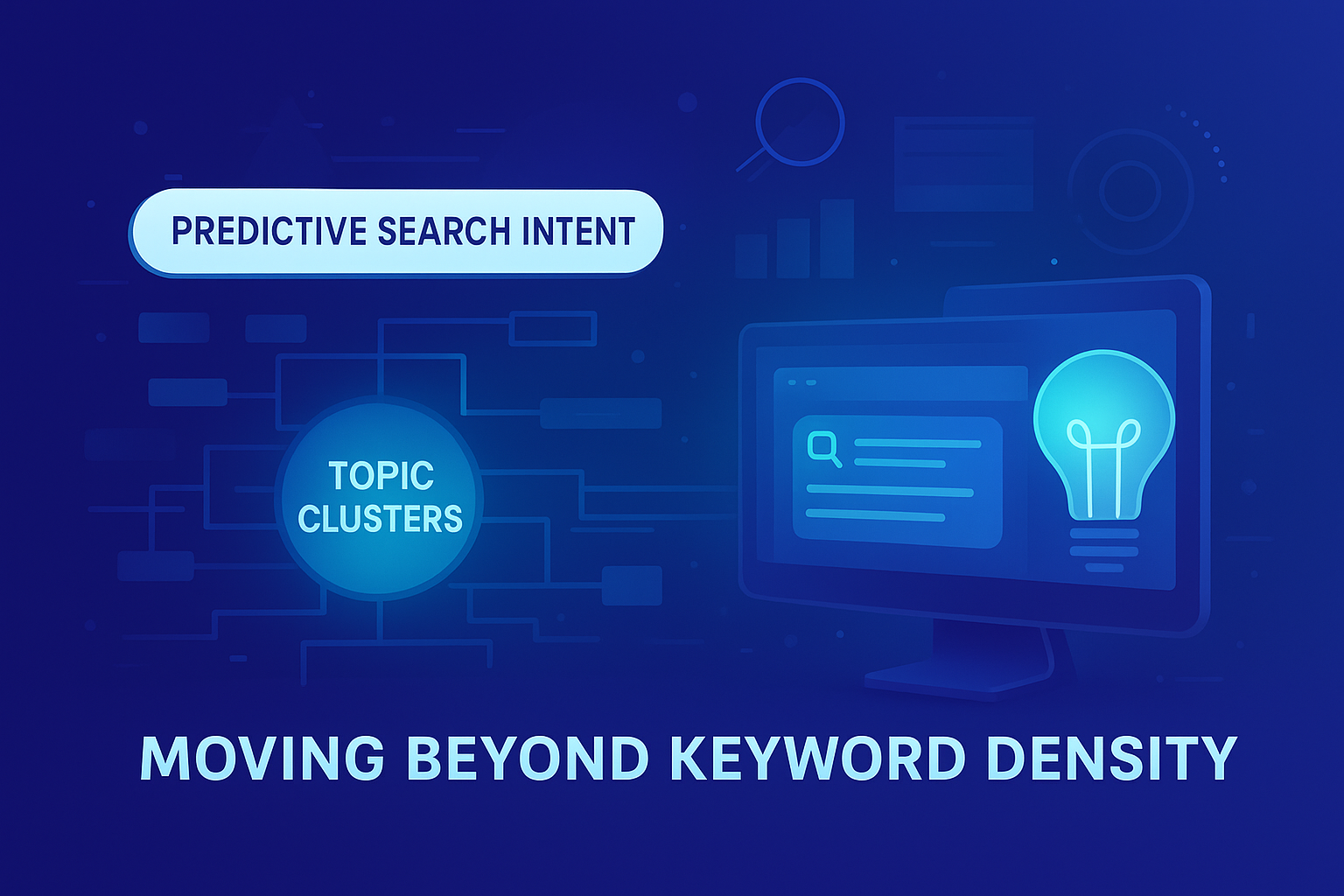
Search engine optimization (SEO) has evolved dramatically over the past decade. Gone are the days when keyword density alone determined rankings. Today, search engines like Google use AI-driven algorithms and natural language processing (NLP) to understand predictive search intent, user context, and content relationships.
This shift has created two essential strategies for modern SEO: topic clusters. Together, they move beyond traditional keyword stuffing, helping websites rank higher while improving user experience.
In this article, we’ll explore what predictive search intent is, how topic clusters work, and how you can integrate them into your SEO strategy.
What is Predictive Search Intent?
Predictive search intent is the process of anticipating what a user is likely to search for before they finish typing a query. It goes beyond matching exact words, instead focusing on context, behavior, and historical patterns.
Google and other search engines use:
-
Machine learning (ML): To predict user queries in real-time.
-
User behavior signals: Past searches, location, and device type.
-
Semantic understanding: Analyzing the meaning of words, not just their spelling.
For example, when someone types “best camera,” predictive search intent suggests related queries like “best camera for beginners” or “best camera under $1000.” This anticipates needs and refines results instantly.
By optimizing for predictive search intent, websites can align their content with what users really want, not just what they type.
Why Keyword Density is No Longer Enough
In early SEO, a page with the highest keyword usage often ranked best. However, search algorithms now prioritize:
-
Content relevance over keyword repetition.
-
Search intent over raw keyword frequency.
-
User experience (UX) signals such as dwell time, bounce rate, and mobile-friendliness.
Keyword density alone can even hurt rankings if search engines detect “keyword stuffing.” Instead, predictive search intent and topic clusters provide a more natural, structured way to optimize content.
What are Topic Clusters?
A topic cluster is an SEO content strategy where a central “pillar page” covers a broad topic, and multiple supporting “cluster pages” address related subtopics.
Structure of a Topic Cluster:
-
Pillar Page:
-
Broad overview of the topic (e.g., “SEO Strategies in 2025”).
-
Links out to more detailed cluster content.
-
-
Cluster Pages:
-
Cover subtopics in depth (e.g., “Predictive Search Intent,” “Visual Search SEO,” “AI in Content Creation”).
-
Link back to the pillar page.
-
-
Internal Linking:
-
Creates a web of connections that signals authority and relevance to search engines.
-
Topic clusters ensure that your website covers a subject comprehensively, building topical authority and improving rankings across multiple keywords.
The Role of Predictive Search Intent in Topic Clusters
When combined, predictive search intent and topic clusters create a future-ready SEO strategy:
-
Predictive intent identifies what users are likely to search next.
-
Topic clusters ensure your content answers all related queries.
-
Together, they improve SERP visibility, click-through rates (CTR), and user satisfaction.
For example:
If your pillar page is about “Content Marketing”, predictive intent analysis might reveal rising searches for:
-
“AI in content marketing”
-
“Content repurposing strategies”
-
“Interactive content examples”
These become cluster pages, linked to the pillar, creating a strong network optimized for user intent.
Benefits of Moving Beyond Keyword Density
-
Better User Experience
Predictive search ensures users find relevant answers quickly. -
Higher SERP Rankings
Topic clusters demonstrate topical authority, boosting rankings. -
Voice Search Optimization
Anticipating natural language queries aligns with voice search growth. -
Content Longevity
Intent-driven content adapts better to algorithm updates. -
Reduced Bounce Rates
Users stay longer when they find deeper, related answers.
How to Optimize for Predictive Search Intent
1. Conduct Intent-Based Keyword Research
-
Use tools like SEMRush, Ahrefs, or Google Keyword Planner.
-
Look for “people also ask” and autocomplete queries.
-
Segment queries by navigational, informational, transactional, and commercial intent.
2. Use AI and Analytics Tools
-
Predict user paths with Google Analytics 4 (GA4).
-
Use AI-powered SEO tools that provide query intent classification.
3. Optimize for Long-Tail Queries
Predictive search thrives on specific, conversational queries.
E.g., Instead of “running shoes,” optimize for “best running shoes for flat feet 2025.”
4. Leverage Search Features
-
Target featured snippets for quick answers.
-
Optimize for People Also Ask boxes.
-
Add structured data (schema) to enhance rich snippets.
How to Build Topic Clusters
Step 1: Identify Core Pillar Topics
Choose broad, evergreen subjects (e.g., “Digital Marketing Trends”).
Step 2: Map Cluster Subtopics
Brainstorm user questions and predictive queries.
E.g., For “SEO Trends”:
-
Predictive search intent
-
Visual search SEO
-
AI-powered SEO tools
Step 3: Create a Pillar Page
Write a comprehensive guide (3,000+ words) covering the broad topic.
Step 4: Develop Cluster Pages
Each cluster page should focus on one aspect in depth.
Step 5: Interlink Strategically
-
Link clusters to pillar.
-
Link clusters to each other when relevant.
Tools to Support Predictive Search & Topic Clusters
-
Google Search Console: Identifies queries driving impressions.
-
SEMRush Topic Research Tool: Maps out related subtopics.
-
AnswerThePublic: Generates predictive query suggestions.
-
MarketMuse & Clearscope: AI-driven topic clustering.
-
Surfer SEO: Optimizes semantic relevance beyond keyword density.
Predictive Search Intent & Voice Search
Voice assistants like Alexa, Siri, and Google Assistant rely heavily on predictive search intent. Queries are often conversational, such as:
-
“What’s the best coffee shop near me?”
-
“How do I optimize for predictive search intent?”
To capture voice search traffic:
-
Use natural language in content.
-
Add FAQ sections with conversational tone.
-
Optimize for local SEO when relevant.
Common Mistakes to Avoid
-
Over-optimizing keywords instead of focusing on intent.
-
Creating isolated articles without cluster linking.
-
Ignoring long-tail and conversational queries.
-
Not updating clusters as predictive trends evolve.
FAQs on Predictive Search Intent & Topic Clusters
Q1. What is predictive search intent in SEO?
It’s the process of anticipating what users are likely to search based on patterns, context, and behavior, rather than just keywords.
Q2. How do topic clusters improve SEO?
They organize content into interconnected groups, showing search engines that your site has topical authority.
Q3. Is keyword density still important?
Only to a minor extent. Modern SEO prioritizes intent, context, and relevance over repetition.
Q4. Can predictive search help with featured snippets?
Yes. Anticipating user questions improves chances of ranking in snippets and People Also Ask boxes.
Q5. Do topic clusters work for small websites?
Absolutely. Even small blogs can build authority by creating a strong cluster around a niche topic.
Conclusion
SEO is no longer about counting keywords—it’s about understanding searchers. Predictive search intent helps anticipate queries, while topic clusters ensure your site answers them comprehensively. Together, they build topical authority, improve rankings, and future-proof your SEO strategy.
By moving beyond keyword density and embracing intent-driven SEO, you can dominate SERPs in the era of AI-powered search.